Uses & Synthesis Methods
Antidepressant Fluoxetine
Mechanism of Action
Pharmacokinetics
Precautions
Chemical Properties (Fluoxetine Hydrochloride)
Uses
Production Methods | Uses & Synthesis Methods
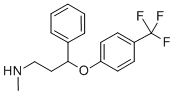
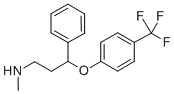
Antidepressant Fluoxetine: Fluoxetine is a selective serotonin reuptake inhibitor (SSRI) type antidepressant. Its pharmaceutical form is fluoxetine hydrochloride, marketed under the trade name "Prozac". Developed by Eli Lilly and Company, it was introduced to the market in the 1990s for the treatment of major depressive disorder, obsessive-compulsive disorder (OCD), bulimia nervosa, and panic disorder with or without agoraphobia. It has good antidepressant effects and is currently widely used clinically as a first-line antidepressant.
Primary Pharmacological Action: Its main pharmacological action is the selective inhibition of the reuptake of serotonin (5-HT) released from presynaptic neurons in the central nervous system, hence it is also known as a selective serotonin reuptake inhibitor. It has virtually no binding affinity for other receptors such as α-adrenergic, β-adrenergic, serotonergic, or dopaminergic receptors.
Pharmacokinetics: Fluoxetine is well absorbed from the gastrointestinal tract after oral administration, with peak plasma concentrations achieved approximately 6-8 hours post-dose. Food intake does not affect its bioavailability. It is approximately 95% bound to plasma proteins and is widely distributed. Steady-state plasma concentrations are reached after several weeks of dosing. It is metabolized by the liver via demethylation to its active metabolite, norfluoxetine. The elimination half-life of fluoxetine is 4-6 days, and for norfluoxetine it is 4-16 days. It is primarily excreted by the kidneys. As it is excreted into breast milk, caution is advised when prescribing to pregnant and nursing women.
Precautions:
1. Side effects are numerous. Common adverse reactions include systemic or local allergic reactions, gastrointestinal disturbances (such as nausea, vomiting, dyspepsia, diarrhea, dysphagia), anorexia, dizziness, headache, sleep abnormalities, fatigue, abnormal mental status, sexual dysfunction, visual disturbances, dyspnea, etc.
2. Fluoxetine is contraindicated in patients currently using monoamine oxidase inhibitors (MAOIs).
3. In patients with hepatic insufficiency, the half-lives of fluoxetine and norfluoxetine are increased to 7 days and 14 days, respectively. Therefore, a reduction in dose or dosing frequency should be considered.
Chemical Properties (Fluoxetine Hydrochloride): Fluoxetine Hydrochloride: C₁₇H₁₈F₃NO·HCl [59333-67-4]. White to off-white crystalline solid, melting point 158.4-158.9°C. Freely soluble in methanol or ethanol, soluble in acetonitrile, acetone, or chloroform, slightly soluble in ethyl acetate, dichloromethane, or water (with sonication at pH 1.2, 4.5, 7.0), practically insoluble in cyclohexane, hexane, or toluene. Solubility (mg/mL): Methanol and ethanol >100, Acetone, acetonitrile, and chloroform 33-100, Dichloromethane 5-10, Water 1-2, Ethyl acetate 2-2.5, Cyclohexane, hexane, and toluene 0.5-0.67. Maximum solubility in water: 14 mg/mL. UV max (methanol): 227, 264, 268, 275 nm (E¹%₁cm 372.0, 29.2, 29.3, 21.5). Acute toxicity LD₅₀ (mouse, rat): 248, 452 mg/kg (oral).
Uses: A novel antidepressant that inhibits the reuptake of 5-HT by nerve cells. Due to the long half-life of both the drug and its active metabolite (several days after chronic administration) and few other direct pharmacological effects, its toxicity and side effects are minimal. It may also be effective for obsessive-compulsive disorder (OCD). Used for various types of depression accompanied by anxiety.
Production Methods:
Method 1: Acetophenone, paraformaldehyde, and methylamine undergo a Mannich reaction to yield the hydrochloride salt of β-methylaminopropiophenone and the hydrochloride salt of bis[N-(2-benzoyl)ethyl]methylamine. Only the former is needed for fluoxetine preparation; the latter is a byproduct. The tertiary amine byproduct can be decomposed into the useful secondary amine via steam distillation. The secondary amine obtained is added to an aqueous potassium carbonate solution, followed by ethanol to dissolve. Potassium borohydride is added in portions, and the reaction is continued after complete addition. Ethanol is evaporated under reduced pressure. The residue is extracted first with diethyl ether and then with chloroform. The combined extracts are washed with brine to pH 8.0, dried, and filtered. The organic solvent is evaporated under reduced pressure. The residue is recrystallized from hexane to yield N-methyl-3-phenyl-3-hydroxypropylamine (89.7% yield). This is dissolved in N,N-dimethylacetamide (DMAC), sodium hydride is added, and the temperature is slowly raised to 70°C and maintained. Potassium iodide and 4-chlorobenzotrifluoride are added, and the temperature is raised to 90°C for reaction. The mixture is diluted with water and extracted with diethyl ether. The extract is washed with brine to pH 8.0, dried, filtered, and hydrogen chloride gas is bubbled through until pH 1.0, then allowed to stand. The precipitate is collected by filtration, dried, and recrystallized from ethyl acetate to yield fluoxetine hydrochloride (80% yield), melting point 152-153°C.
Method 2: β-Methylaminopropiophenone is reduced to the alcohol using borane, then chlorinated using thionyl chloride to yield 3-methylamino-1-phenyl-1-propanol, which is then reacted with sodium 4-trifluorophenoxide to produce fluoxetine.
Method 3: 8.1 g of cyanogen bromide is dissolved in 500 ml of benzene and 50 ml of toluene. Under stirring at 5°C with nitrogen bubbling, a solution of 12.146 g of N,N-dimethyl-3-(4-trifluoromethylphenoxy)-3-phenylpropylamine in 40 ml of benzene is added dropwise. The reaction temperature is allowed to rise to room temperature, and stirring is continued overnight under a nitrogen atmosphere. 100 ml of benzene is added, and the reaction mixture is washed twice with water, once with 1 mol/L sulfuric acid, and then with water until neutral. After drying, the solvent is evaporated under reduced pressure to yield 9.5 g of oily N-methyl-N-cyano-3-(4-trifluoromethylphenoxy)-3-phenylpropylamine. 100 g of potassium hydroxide, 85 ml of water, 400 ml of ethylene glycol, and 9.50 g of N-methyl-N-cyano-3-(4-trifluoromethylphenoxy)-3-phenylpropylamine are refluxed together at 130°C for 20 hours, then cooled. After adding 500 ml of water, the mixture is extracted with three 500 ml portions of diethyl ether. The combined extracts are washed with water, then extracted with 2 mol/L hydrochloric acid. The separate aqueous extracts are combined. The organic layer is extracted once with 2 mol/L hydrochloric acid, three times with water, and once with saturated sodium chloride solution. All aqueous extracts are combined and basified with 5 mol/L sodium hydroxide solution. Fluoxetine precipitates out as it is insoluble in basic aqueous solution. It is extracted three times with diethyl ether, and the combined extracts are washed with saturated sodium chloride solution, dried, and the ether is evaporated under reduced pressure to yield 6.3 g of fluoxetine.
td> |